How we know Series - Part 2 - Who gets to decide?
Part 2: Who Gets to Decide?
In the first part of this series, I suggested that before Christians ask whether something is biblical, we first need to ask a much more fundamental question.
What do we actually mean when we call something “biblical”?
My goal wasn’t to answer that question completely. It was to slow us down long enough to realize that there are important questions sitting underneath almost every theological debate Christians have with one another. Questions about interpretation. Questions about authority. Questions about how we arrive at theological truth in the first place.
Whether we realize it or not, every Christian already has a method.
We all have assumptions about how Scripture should be read.
We all have assumptions about what counts as a legitimate doctrine.
We all have assumptions about how much weight should be given to history, tradition, reason, councils, teachers, and the Church itself.
Those assumptions begin shaping our conclusions long before we ever say, “The Bible teaches…”
In other words, none of us simply reads the Bible.
We all read it through a framework.
That leads me to the next question that completely changed the way I began thinking about Christianity.
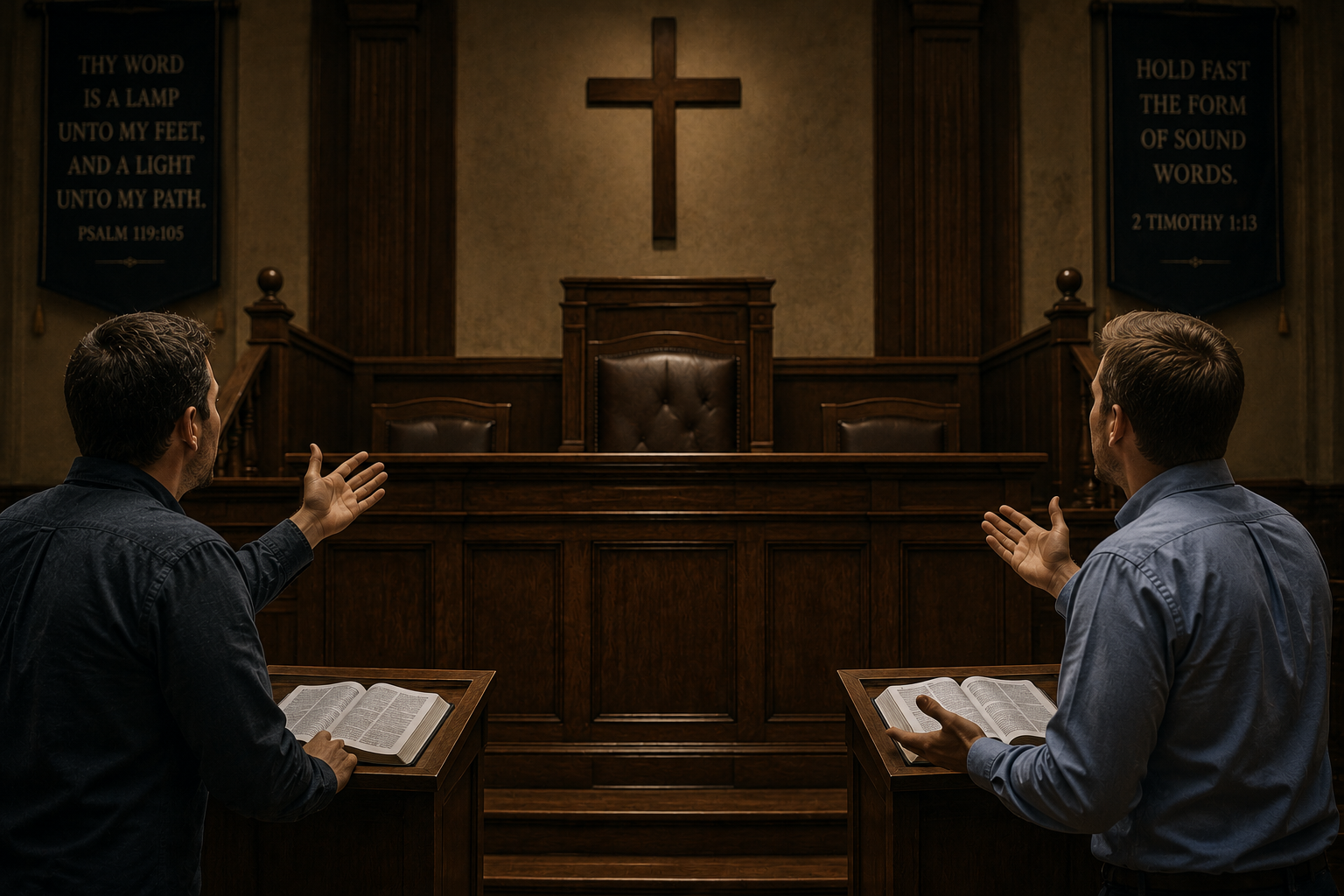
Who gets to decide when an interpretation is actually correct?
At first glance, that sounds like a Catholic question.
I don’t think it is.
I think it’s simply a human question.
Imagine two sincere Christians.
Both love Jesus.
Both believe the Bible is the inspired Word of God.
Both pray.
Both sincerely desire to obey Christ.
Both have spent years studying Scripture.
Yet one believes baptism is a means by which God communicates grace.
The other believes baptism is merely an outward symbol.
One believes Christ is truly present in the Eucharist.
The other believes Communion is only symbolic.
One baptizes infants.
The other refuses.
One believes salvation can ultimately be rejected.
The other believes it cannot.
Neither of these people is trying to deceive anyone.
Both sincerely believe they’re following Scripture.
Both can quote verses.
Both can defend their position.
So how do we determine who is interpreting Scripture faithfully?
Not who is more passionate.
Not who has memorized more verses.
Not who has the larger church.
Not who has the better podcast.
Who is actually right?
Notice what happened.
The moment Christians disagree over the meaning of Scripture, we’ve already moved beyond Scripture itself.
We’ve entered the question of authority.
Who has the authority to say that one interpretation is faithful while another is not?
The more I studied Christian history, the more I realized this isn’t a modern problem.
It isn’t a Protestant problem.
It isn’t a Catholic problem.
It’s been with Christianity from the very beginning.
One of the clearest examples is found in Acts 15.
Some Jewish believers insisted that Gentile converts had to be circumcised and keep the Law of Moses.
Others disagreed.
This wasn’t a minor disagreement over church preferences.
It touched the very heart of the Gospel.
It affected how people understood salvation itself.
What’s fascinating isn’t simply the conclusion they reached.
It’s the process they followed.
The believers didn’t separate into competing congregations.
Peter didn’t leave and start “Peter Chapel.”
James didn’t start “The Jerusalem Bible Church.”
Paul didn’t announce that he had received a private revelation and therefore everyone else was wrong.
The apostles and elders gathered together.
They debated.
They listened.
Peter spoke.
Paul and Barnabas testified about what God had been doing among the Gentiles.
James appealed to the Scriptures.
Then, together, the Church reached a judgment.
One sentence has stayed with me ever since I first noticed it.
“For it has seemed good to the Holy Spirit and to us…” (Acts 15:28)
I’ve read that sentence dozens of times.
Every time I do, I stop.
Because that’s an extraordinary thing to say.
The Church didn’t merely say,
“Here’s our opinion.”
Nor did they simply quote a verse and end the discussion.
They deliberated together under apostolic authority and concluded that the Holy Spirit had guided the Church in its judgment.
That observation forced me to ask another question.
Is that event merely descriptive?
Or does it show us something about how Christ intended doctrinal disputes to be resolved?
That question lingered with me.
Then another passage began raising questions I had never really considered before.
In Acts 8, Philip encounters an Ethiopian official returning from Jerusalem. He’s sitting in his chariot reading from the prophet Isaiah.
This wasn’t an atheist.
This wasn’t someone openly hostile to God.
Here was a man who had traveled to Jerusalem to worship. He was reading the Scriptures. He sincerely wanted to understand what he was reading.
Philip approaches him and asks a simple question.
“Do you understand what you are reading?”
The official’s response has always struck me.
“How can I, unless someone guides me?” (Acts 8:30–31)
Notice what Luke doesn’t say.
He doesn’t say, “Keep reading and eventually you’ll figure it out.”
He doesn’t say, “The Holy Spirit will privately reveal everything you need to know.”
Instead, God sends Philip.
The Scriptures are opened.
The passage is explained.
The Gospel is preached.
The Ethiopian believes.
Now, I don’t think Luke’s point is that ordinary Christians are incapable of understanding Scripture on their own. Nor do I think he’s suggesting that the Bible is so obscure that only experts can understand it.
I think his point is much simpler.
God delights in teaching His people through other people.
He always has.
The apostles taught.
The evangelists taught.
The elders taught.
The bishops taught.
Parents taught their children.
The faith wasn’t simply handed someone in the form of a scroll and left there.
It was preached.
Explained.
Defended.
Handed down.
That observation doesn’t answer every question about biblical interpretation.
But it raises another one.
If God chose to use teachers to explain the Scriptures during the apostolic age, what role did He intend those teachers to have after the apostles were gone?
Then Paul introduced yet another piece of the puzzle.
Writing to the church in Thessalonica, he says,
“So then, brethren, stand firm and hold to the traditions which you were taught by us, either by word of mouth or by letter.” (2 Thessalonians 2:15)
I remember reading that verse and realizing that, regardless of whether I ultimately agreed with Catholic theology, I couldn’t simply pretend Paul hadn’t written those words.
He doesn’t merely tell them to hold fast to what he wrote.
He also tells them to hold fast to what he taught them orally.
Immediately my mind started asking questions.
What happened to those teachings?
How were they preserved?
Who was responsible for protecting them?
Who determined whether they had been faithfully handed down?
Those questions pushed me in a direction I honestly wasn’t expecting.
Instead of looking at modern debates first, I found myself becoming increasingly interested in the generations immediately following the apostles.
If I wanted to know how the apostles expected the Church to function after they were gone, why wouldn’t I start by reading the people who actually learned from them or from their disciples?
That search introduced me to what Christians commonly call the Church Fathers.
Growing up, I had heard the phrase “Church Fathers” many times.
Usually it was mentioned with some degree of suspicion, almost as though this was the point where Christianity slowly drifted away from the Bible and became increasingly corrupted.
I’ll admit, I accepted that narrative for a long time without ever checking it for myself.
Then I actually started reading them.
What I discovered surprised me.
These weren’t medieval philosophers inventing elaborate theological systems centuries after Christ.
These were pastors.
Bishops.
Teachers.
Men responsible for shepherding Christian communities in the generations immediately following the apostles.
Many of them lived during times of intense persecution.
Some of them personally knew the apostles or were disciples of men who did.
What struck me wasn’t simply what they believed.
It was how they thought.
How they approached Scripture.
How they handled disagreement.
How they understood the relationship between the Bible, the Church, and apostolic teaching.
I kept seeing the same pattern over and over again.
Scripture occupied the highest place in the life of the Church.
But Scripture was never isolated from the Church that received it.
It wasn’t treated as though every individual Christian became his own final authority the moment he opened a scroll.
Instead, Scripture was read publicly.
Preached publicly.
Explained publicly.
Its interpretation was measured against what the Church had already received from the apostles.
And when serious disagreements arose, Christians didn’t immediately divide into competing churches.
They gathered.
They debated.
They prayed.
They appealed to what had been handed down.
The more I read, the more five observations continued surfacing.
First, Scripture was always treated as the inspired Word of God and held the highest place in the life of the Church.
Second, Scripture was entrusted to faithful men who had been appointed to teach and preserve the apostolic faith.
Third, novel interpretations weren’t automatically celebrated because they sounded convincing. They were tested by the wider Church.
Fourth, interpretation consistently followed what many early Christians referred to as the Rule of Faith—the apostolic summary of Christian belief that served as a guide for reading Scripture faithfully.
Finally, personal insight never stood above the faith that had already been entrusted to the Church.
Those observations didn’t instantly make me Catholic.
But they completely changed the kinds of questions I was asking.
Instead of asking,
“Who has the best interpretation?”
I found myself asking,
“Who has the authority to preserve the apostolic interpretation?”
That is a very different question.
And once I started asking it, I realized it reached far beyond theology.
It touched almost every area of life.
In my own profession as a sign contractor, I deal with rules, codes, and regulations almost every day.
Every sign I design and install has to comply with local building codes, zoning ordinances, electrical codes, ADA requirements, engineering standards, and countless other regulations.
Those rules are written down.
But anyone who has worked in construction knows something that people outside the industry often don’t.
Written rules do not interpret themselves.
Sometimes the language is straightforward.
Sometimes it isn’t.
Sometimes two contractors can read the exact same paragraph and honestly arrive at different conclusions about what the code requires.
When that happens, we don’t each get to build according to our own interpretation.
The chief plans examiner makes the determination.
His interpretation becomes the one the city follows.
Not because he’s smarter than everyone else.
Not because he’s incapable of making mistakes.
But because every functioning system requires an authoritative interpreter if it hopes to maintain unity.
Imagine what our cities would look like if that authority didn’t exist.
Imagine every contractor walking into the permitting office saying,
“Well… this is how I interpret the code.”
Another replies,
“I disagree.”
A third says,
“The Spirit led me to understand it differently.”
Eventually the code itself would become meaningless because everyone would claim the written standard while following their own interpretation of it.
The result wouldn’t be freedom.
It would be chaos.
Our legal system works much the same way.
We have constitutions.
We have statutes.
We have case law.
All of it is written.
Yet no one imagines that written law alone is sufficient to settle every dispute.
That’s why courts exist.
That’s why appellate courts exist.
That’s why supreme courts exist.
Not because the written law is unimportant.
But because written law requires authoritative interpretation if it is going to be applied consistently.
As I reflected on those examples, I found myself asking a question that I couldn’t shake.
If God gave His Church a written revelation…
Did He also establish an authoritative means of preserving, interpreting, and protecting that revelation?
Or did He intend every generation of Christians to begin that work again from scratch?
Some people might immediately answer,
“The Holy Spirit guides every believer.”
I agree.
The Holy Spirit absolutely guides believers.
But that’s not the question.
The question is this:
If two believers, both sincerely seeking Christ, both praying, both reading the same Scriptures, and both believing they are being led by the Holy Spirit arrive at contradictory conclusions…
How does the Church determine which interpretation faithfully represents the apostolic faith?
That’s the question I don’t think we can simply brush aside.
Because eventually every Christian answers it.
Whether consciously or unconsciously.
Whether Catholic.
Orthodox.
Protestant.
Or non-denominational.
Everyone has an answer.
Some place that authority in the individual conscience.
Others in confessions and denominational statements.
Others in scholarly consensus.
Others in the historic episcopate.
Others in ecumenical councils.
But no one escapes the question.
Every Christian has some way of determining which interpretations should be accepted and which should be rejected.
For me, this became one of the biggest turning points in my journey.
I realized I wasn’t simply asking,
“What does the Bible say?”
I was asking,
“How did Christ intend His Church to know what the Bible means?”
Those are not the same question.
One asks about the content of revelation.
The other asks about the means by which that revelation is faithfully preserved and understood.
The more I thought about it, the more I became convinced that this wasn’t simply an interesting theological discussion.
It was one of the defining questions of Christianity.
Because once we’ve established a rule for determining what counts as biblical, another question immediately follows.
Who has the authority to say that our rule is the correct one?
I don’t think that’s merely a Catholic question.
I don’t think it’s merely a Protestant question.
I think it’s one of the most important Christian questions we can ask.
And it naturally leads us to the next part of this series.
Because if we’re going to talk about authority, we have to go back to the people who stood closest to the apostles themselves.
What did they believe about Scripture?
How did they handle disagreement?
What did they think the Church was?
And perhaps most importantly…
How did they believe Christ intended His people to preserve the faith once the apostles were gone?
That’s where we’re headed next

0 Reflections
No reflections yet. Be the first to share one.
Leave a reflection