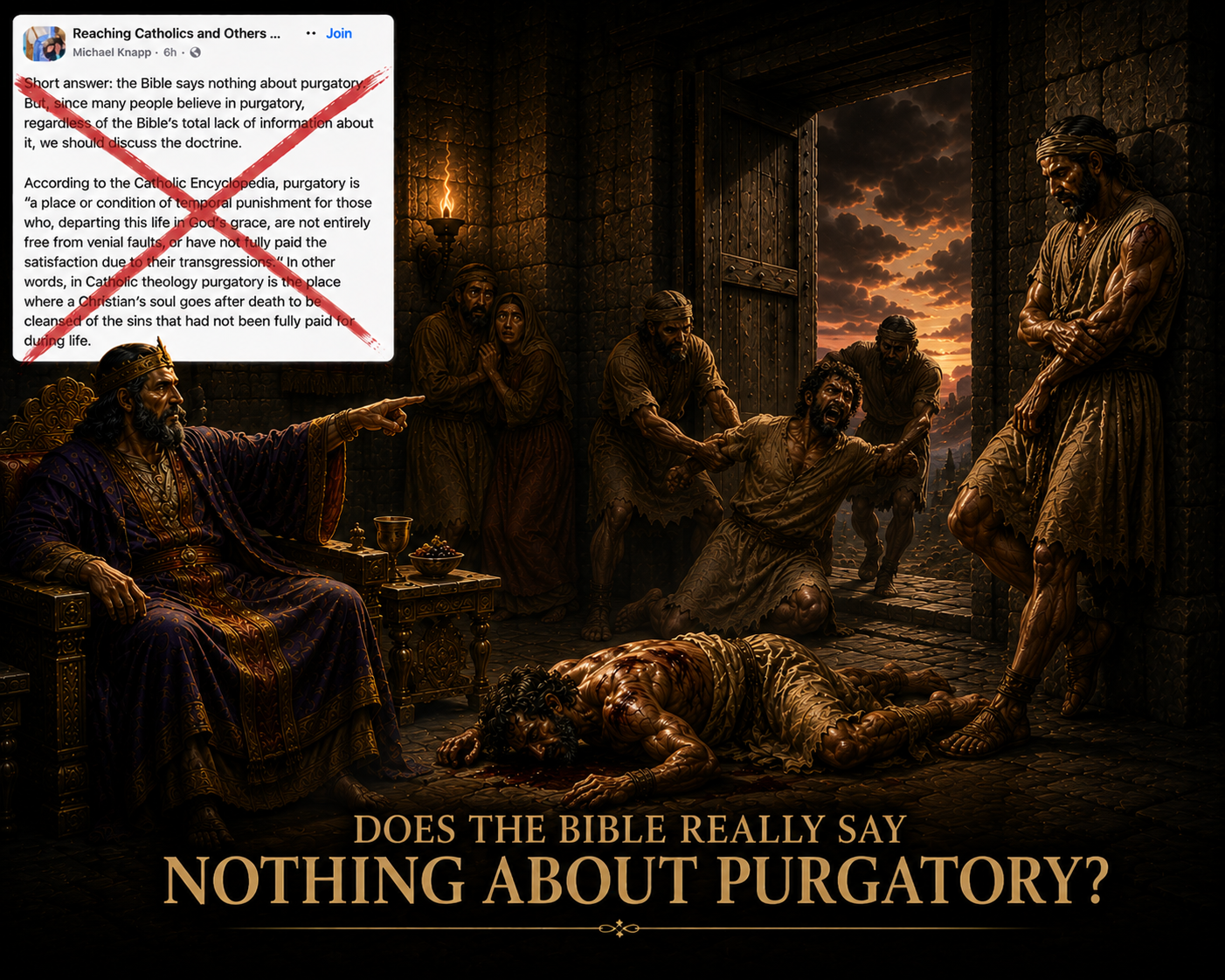
Responding to the Claim that the Bible Says Nothing About Purgatory
Does the Bible Really Say Nothing About Purgatory?
This morning, while having breakfast at First Watch with my wife and kids, I mentioned to my wife that my Facebook algorithm has somehow turned almost entirely into debates between Catholics and Protestants. I never intentionally went looking for that kind of content, but little by little my feed has become filled with discussions about theology, Church history, and biblical interpretation.
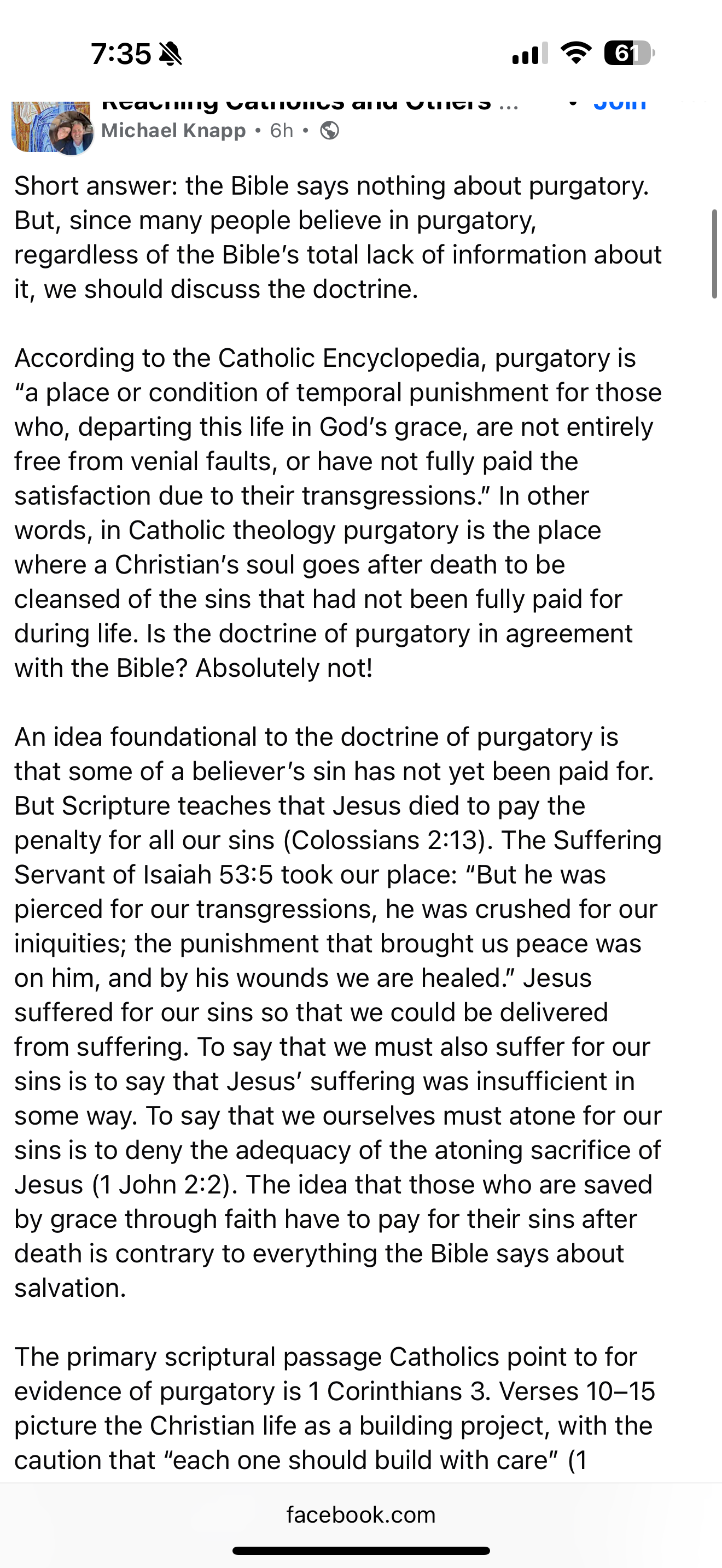
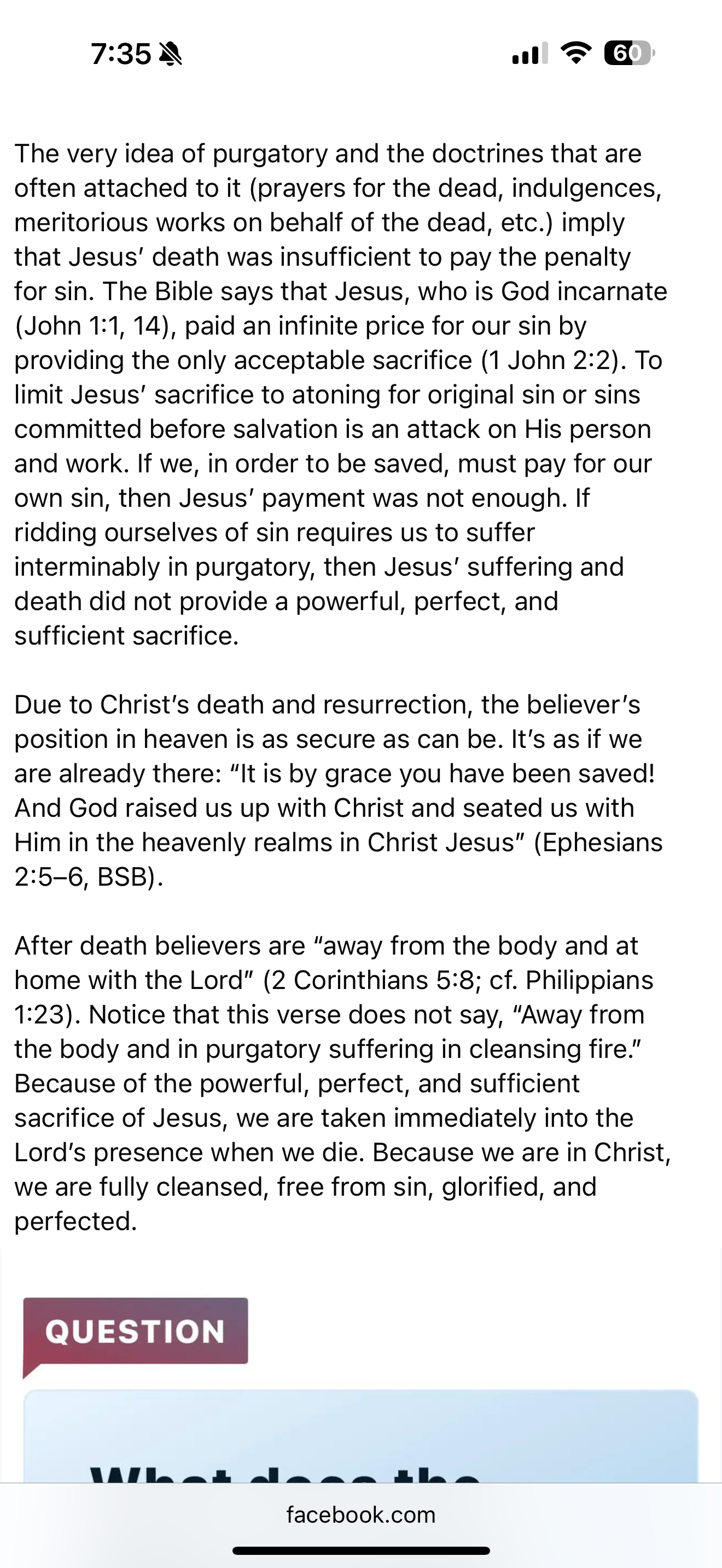
As I was scrolling, I came across a post arguing that the Catholic doctrine of purgatory is completely unbiblical and that the Bible says nothing about it.
Reading it immediately took me back a few years.
When I was a Protestant, I would have agreed with nearly everything the author wrote. If someone had asked me whether purgatory was biblical, I probably would have answered, “Absolutely not.” I assumed it was simply a medieval invention that the Catholic Church had imposed on Christianity.
But after spending years studying Scripture, the early Church, and Catholic theology, I eventually realized something that surprised me.
Purgatory is not a doctrine Catholics invented because they thought Christ’s sacrifice was somehow insufficient. Nor is it a random belief pulled out of thin air to frighten people or control them. Whether one ultimately agrees with the doctrine or not, it deserves to be understood on its own terms. Like the doctrine of the Trinity, purgatory is the result of Christians attempting to reconcile the whole witness of Scripture into a coherent understanding of God’s work of salvation.
The post below presents several objections to purgatory that are common in Protestant circles. Rather than responding emotionally, I’d like to examine each claim carefully.
Before asking whether purgatory is biblical, we should first ask a simpler question:
Is the Catholic doctrine being represented accurately?
What Does the Catholic Church Actually Teach?
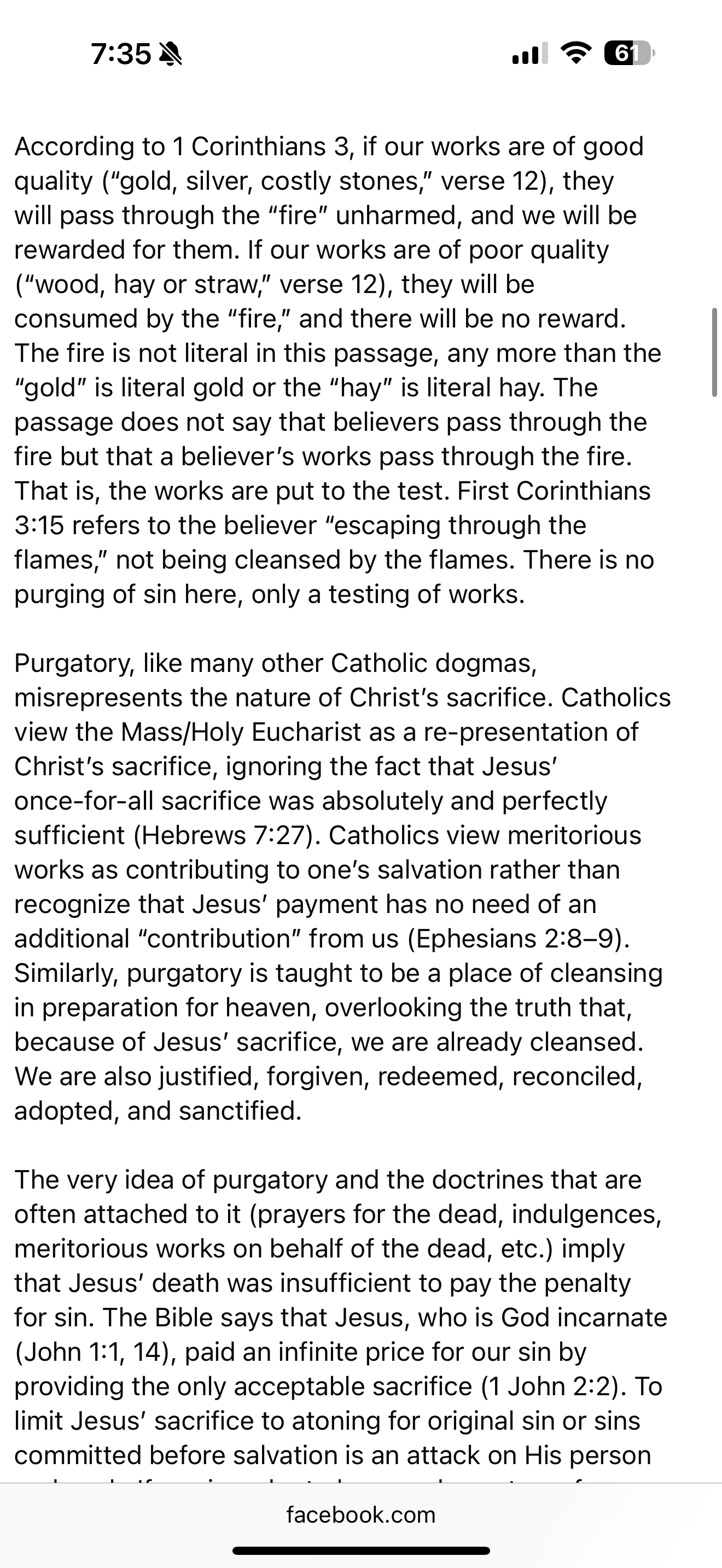
The article begins by quoting an older Catholic reference work and then immediately interprets it through a Protestant understanding of atonement.
The Catechism defines purgatory this way:
“All who die in God’s grace and friendship, but still imperfectly purified, are indeed assured of their eternal salvation; but after death they undergo purification, so as to achieve the holiness necessary to enter the joy of heaven.” (CCC 1030)
Notice what the Catechism actually says.
Those in purgatory:
* die in God’s grace and friendship,
* are already assured of eternal salvation, and
* undergo purification, not condemnation.
That is a far cry from saying Christ failed to pay for their sins.
The article repeatedly frames purgatory as though Catholics believe Jesus paid for some sins while believers must finish paying for the rest after death. That simply is not Catholic doctrine.
The issue isn’t whether Christ’s sacrifice is sufficient. Catholics wholeheartedly affirm that it is.
The question is whether Christ’s saving work merely declares us righteous, or whether it also makes us righteous by completing our sanctification.
That distinction changes the entire discussion.
Forgiveness Does Not Always Remove Every Consequence
One assumption runs throughout the article:
“If Christ has forgiven someone, then there can be no further consequences.”
Scripture simply doesn’t teach that.
Consider David.
After committing adultery with Bathsheba and orchestrating Uriah’s death, David repents.
Nathan tells him:
“The Lord also has put away your sin; you shall not die.” (2 Samuel 12:13)
David is forgiven.
His guilt is removed.
Yet Nathan immediately adds:
“Nevertheless… the child who is born to you shall die.” (2 Samuel 12:14)
And the consequences continue.
Violence remains in David’s household.
His family is torn apart.
His kingdom experiences turmoil.
None of this means God failed to forgive David.
Rather, it demonstrates an important biblical principle:
Forgiveness and the removal of every consequence are not the same thing.
The same principle appears throughout Scripture.
Hebrews tells us:
“The Lord disciplines the one He loves.”
God disciplines His children precisely because they belong to Him.
Discipline is not condemnation.
It is sanctification.
Christ Calls His People to Share His Sufferings
This same principle continues into the New Testament.
When Jesus calls Saul of Tarsus, He tells Ananias:
“I will show him how much he must suffer for the sake of My name.” (Acts 9:16)
Paul had already been chosen by Christ.
His suffering was not payment for his sins.
It was part of God’s work of conforming him to Christ.
Paul later writes:
“If we endure, we will also reign with Him.” (2 Timothy 2:12)
Romans tells us we are glorified if we suffer with Him.
Peter tells believers to rejoice when they share Christ’s sufferings.
Jesus Himself tells every disciple:
“If anyone would come after Me, let him deny himself, take up his cross daily, and follow Me.”
The New Testament consistently teaches that Christians are united with Christ not only in His resurrection but also in His sufferings.
This suffering does not compete with Christ’s atoning work.
It is one of the ways Christ applies His grace and conforms us to His image.
The Biblical Problem Every Christian Must Answer
Now we arrive at the real question.
Scripture teaches all of the following:
* Christ’s sacrifice is completely sufficient.
* Those who die in God’s grace are saved.
* Nothing unclean shall enter heaven.
* Without holiness no one will see the Lord.
* God continues sanctifying His people.
* Most Christians die before reaching perfect holiness.
Every Christian must explain how these truths fit together.
The Catholic doctrine of purgatory is not an attempt to add to Christ’s work.
It is an attempt to explain how Christ completes His work.
As Paul writes:
“He who began a good work in you will bring it to completion at the day of Jesus Christ.” (Philippians 1:6)
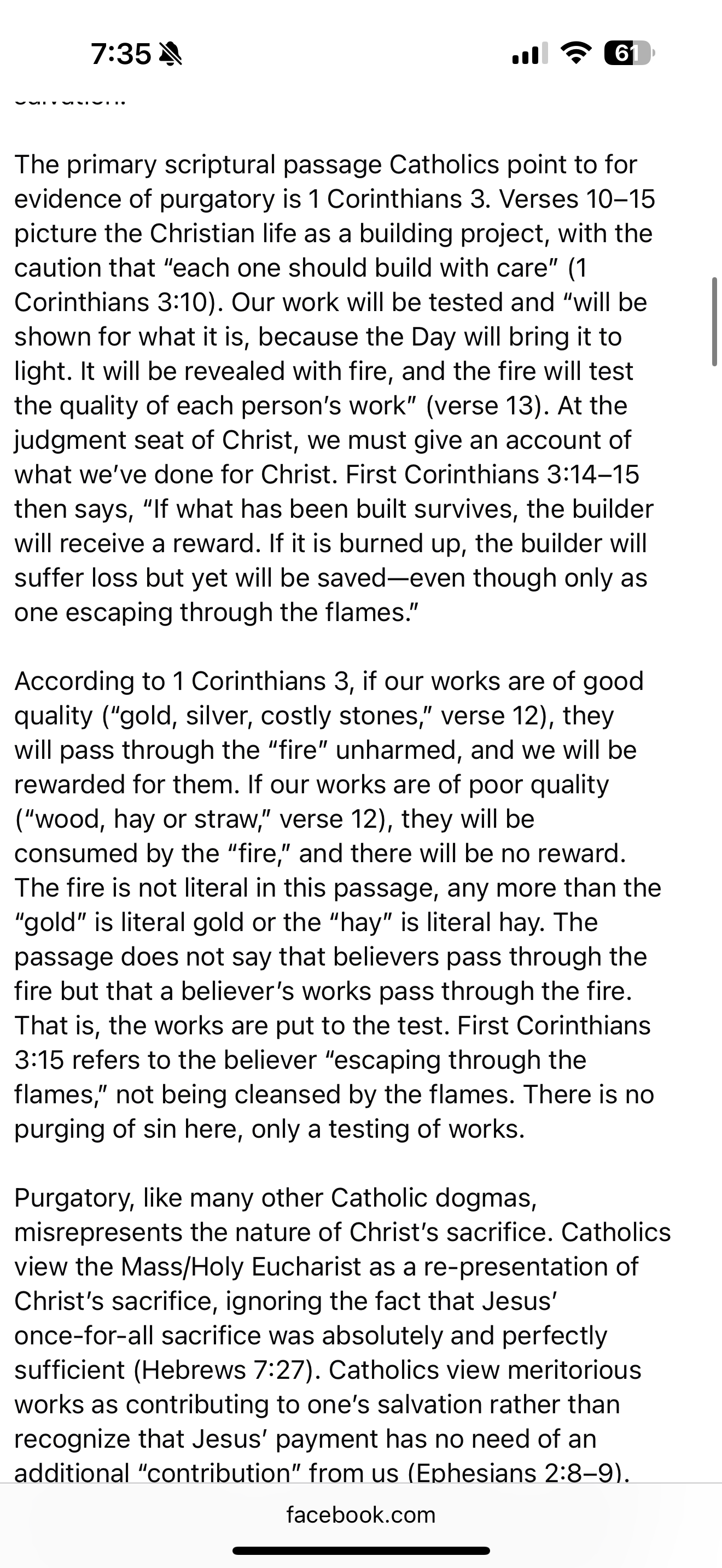
What About 1 Corinthians 3?
One of the passages frequently discussed is 1 Corinthians 3.
Paul describes a believer whose works are tested by fire.
Some works are burned away.
Yet Paul says:
“He himself will be saved, but only as through fire.”
Does this passage explicitly teach purgatory?
No.
But it certainly describes a saved individual experiencing a purifying judgment associated with fire.
That imagery echoes the Old Testament, where fire repeatedly symbolizes God’s work of purification rather than mere destruction.
At the very least, this passage deserves more careful consideration than simply dismissing it as “about rewards.”
The Parable of the Faithful and Unfaithful Servants
Jesus also tells the parable in Luke 12 where servants receive different degrees of punishment.
One servant receives many blows.
Another receives few.
Catholics have long pointed to this passage, not because it proves purgatory by itself, but because it challenges the idea that God’s judgment consists only of two possibilities: either eternal damnation or no punishment whatsoever.
Jesus presents a more nuanced picture.
Again, this passage is not a standalone proof of purgatory.
But it contributes to the larger biblical pattern.
A Doctrine Drawn from the Whole of Scripture
The word “Trinity” never appears in Scripture.
Neither does “Incarnation.”
Yet Christians rightly affirm these doctrines because they arise from the total witness of God’s Word.
Purgatory is approached in the same way.
It is not built upon a single proof text.
It emerges from reading Scripture as a whole.
It seeks to answer a question every Christian must eventually face:
How does God bring forgiven sinners to the perfect holiness required to stand before Him?
Catholics answer:
Through the all-sufficient grace of Jesus Christ, who continues His sanctifying work until every stain of sin has been removed.
Conclusion
Whether one ultimately accepts the doctrine of purgatory is not the first question.
The first question is whether we are willing to evaluate the doctrine as the Catholic Church actually teaches it.
Too often, debates begin with a caricature.
Catholics are accused of believing that Christ’s sacrifice was insufficient, that believers earn heaven after death, or that purgatory is a second chance for salvation.
None of those claims represent Catholic teaching.
Only after we understand the doctrine correctly can we ask whether Scripture supports it.
As someone who once rejected purgatory myself, I understand why many Protestants struggle with it. I did too. But after years of studying Scripture and the history of the Church, I became convinced that purgatory is not a denial of Christ’s finished work.
It is a testimony to it.
The God who forgives us is also the God who transforms us.
The Christ who justifies us is the same Christ who sanctifies us.
And the One who begins a good work in His people is faithful to bring it to completion
Here are the scriptures referenced In this post in a more organized list for easier reference:
Purification & Holiness
* Hebrews 12:14
* Revelation 21:27
* Philippians 1:6
* 2 Corinthians 3:18
* Philippians 2:12-13
Forgiveness Does Not Remove All Consequences
* 2 Samuel 12:10-14
* Hebrews 12:5-11
* Romans 8:1
Sharing in Christ’s Sufferings
* Luke 9:23
* Acts 9:15-16
* Romans 8:17
* Philippians 3:8-10
* Colossians 1:24
* 2 Timothy 2:11-12
* James 1:2-4
* 1 Peter 4:12-13
Fire as a Symbol of Purification
* 1 Corinthians 3:10-15
* Malachi 3:2-3
* Zechariah 13:9
* Isaiah 6:5-7
* 1 Peter 1:6-7
Judgment After Death
* Luke 12:42-48
* Matthew 12:32
Prayer for the Dead (Deuterocanonical)
* 2 Maccabees 12:38-46

0 Reflections
No reflections yet. Be the first to share one.
Leave a reflection